Children's oppositional defiant disorder and mother-child interpersonal brain synchrony: the role of maternal meta-emotion philosophy.
Wang Peizhong, Ma Jingwei, Qiao Lu, He Ting, Zhang Jintao, Lin Xiuyun
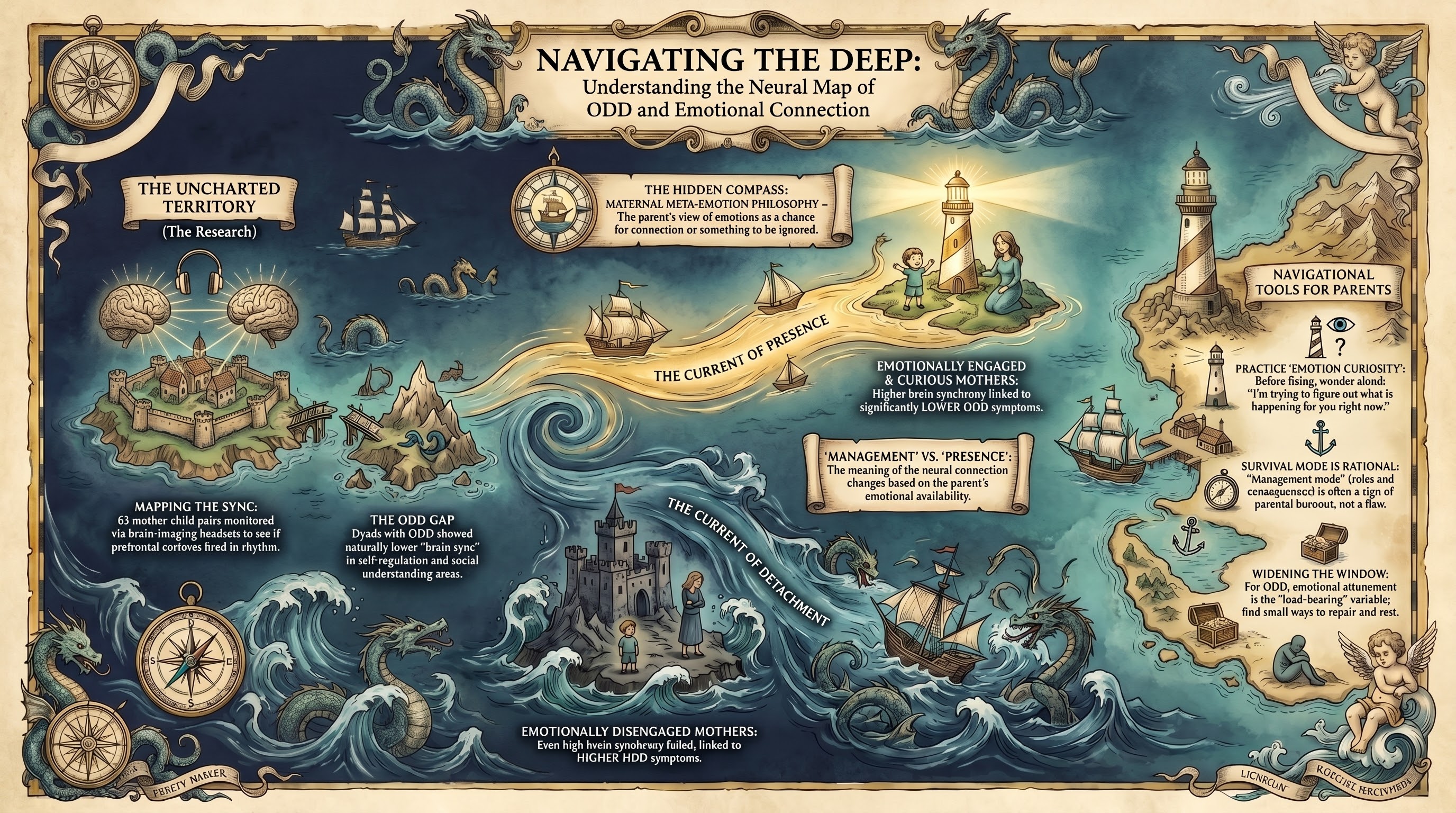
What This Paper Found
Researchers at Beijing Normal University fitted 63 mother-child pairs — 29 where the child had ODD, 34 typically developing — with functional near-infrared spectroscopy (fNIRS) headsets that measure blood flow in the prefrontal cortex. Then they played a cooperative computer game together and measured whether the two brains were “in sync”: rising and falling in activity together in a way that’s associated with genuine coordination and attunement.
The ODD dyads showed clear deficits in interpersonal brain synchrony (IBS) across several brain regions involved in social cognition and self-regulation. But the most striking finding came when the researchers factored in the mothers’ “meta-emotion philosophy” — whether the mother was emotionally engaged with her child’s feelings or more detached from them.
When mothers were emotionally involved — curious about their child’s emotions, willing to be present in them — brain synchrony predicted lower ODD symptoms. When mothers were emotionally disengaged, the same brain synchrony variable predicted higher ODD symptoms. The mother’s emotional stance changed the meaning of the neural signal entirely.
Why This Matters for Your Family
This study lands in territory that can feel uncomfortable to sit with: it’s not just about what strategies you use, it’s about how emotionally present you are when you use them.
That’s not a blame statement. A parent who is burned out, who has had their bids for connection rejected hundreds of times, who has learned to manage rather than attune as a survival strategy — that parent is responding rationally to a genuinely exhausting situation. The research doesn’t say you failed. It says the neural mechanism connecting you to your child works differently when you’re available versus defended, and that difference has measurable effects on ODD symptom severity.
For co-parents, the question this raises is less about who is “doing it right” and more about whether either parent has the current capacity for emotional engagement — and what would need to be different for that capacity to increase. Depletion, conflict, and disconnection all shrink that window. Repair, rest, and regulated relationships widen it.
What You Can Do Today
- Try “emotion curiosity” before problem-solving. When your child with ODD is escalating, a 30-second pause to wonder aloud — “I’m trying to figure out what’s happening for you right now” — is different from managing the behaviour. You don’t have to feel it. You have to be oriented toward it.
- Notice when you’re in management mode versus presence mode. Neither is wrong — there are moments that require management. But if you’re primarily managing, that’s worth noticing as a signal about your own resource levels, not a character trait.
- If co-parents disagree: One parent may be more naturally emotionally engaged; the other more focused on structure and consequence. Both matter. The research suggests emotional attunement is the load-bearing variable for ODD specifically — so if you lean more naturally toward rules and structure, consider whether there’s a way to build a moment of genuine curiosity into the routine, even if it feels unfamiliar.
The Original Paper
Wang, P., Ma, J., Qiao, L., He, T., Zhang, J., & Lin, X. (2026). Children’s oppositional defiant disorder and mother-child interpersonal brain synchrony: the role of maternal meta-emotion philosophy. Journal of Child Psychology and Psychiatry. https://doi.org/10.1111/jcpp.70137
Safety Note: This research summary is for informational purposes only and does not constitute medical or therapeutic advice. Always consult qualified professionals for your family’s specific situation. If you or your child are in crisis, contact your local emergency services or one of these helplines: 988 Suicide & Crisis Lifeline (US) | Lifeline Australia: 13 11 14 | Samaritans UK: 116 123 | Need to Talk? NZ: 1737
Research Brief
Generated by NotebookLM from the original paper. Not a replacement for the peer-reviewed source.
Read Full Brief →