Sleep disorders in children/adolescents with neurodevelopmental and neurological disorders: what evidences do we have with the use of non-pharmacological interventions?
Nunes Magda Lahorgue, El Halal Camila Dos Santos
What This Paper Found
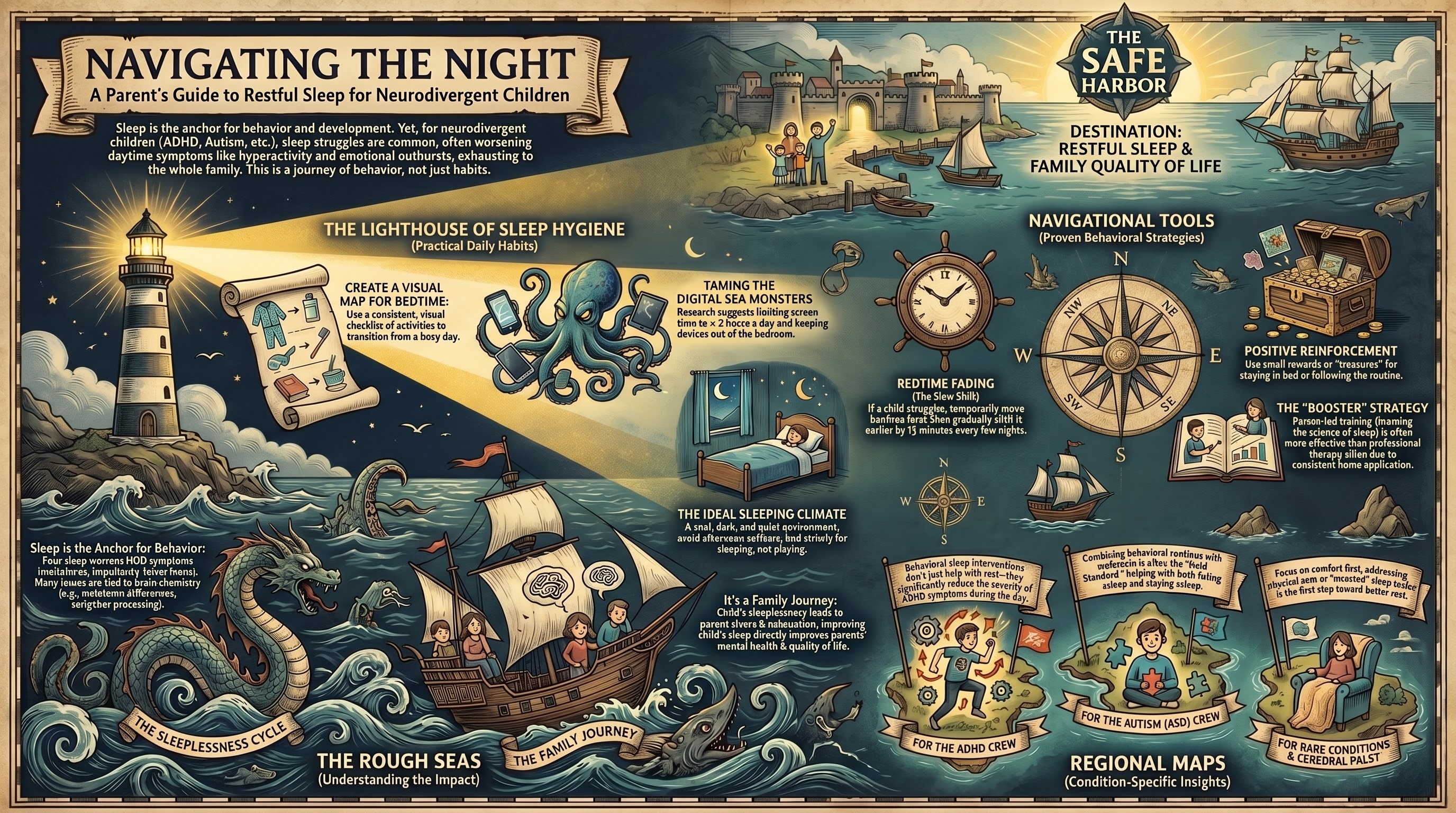
Researchers from the Brain Institute at the Pontifical Catholic University of Rio Grande do Sul reviewed the evidence for non-pharmacological — behavioural and educational — sleep interventions across the main neurodevelopmental conditions: autism spectrum disorder, ADHD, cerebral palsy, epilepsy, and rare genetic neurodevelopmental conditions.
Sleep problems are the rule, not the exception, across these groups. Insomnia symptoms and circadian disturbances are highly prevalent. In autism and ADHD, the research base for behavioral approaches is the strongest of the conditions reviewed.
What those approaches share: psychoeducation (helping families understand the neurobiology of their child’s sleep), sleep hygiene routines, structured bedtime schedules, and — where appropriate — extinction-based strategies that reduce reinforcement of nighttime waking. Parent-led delivery is central to most of the effective programs. And the gains from improving sleep don’t stay in the bedroom: daytime behaviour, attention, and emotional regulation often improve alongside sleep, even when the interventions aren’t targeting those outcomes directly.
The honest caveat: objective sleep measures (actigraphy, polysomnography) show smaller gains than parent-reported measures. The two aren’t measuring quite the same thing, and the gap is worth acknowledging.
Why This Matters for Your Family
Sleep is one of the most reliably under-discussed factors in the families we write for. When a child with autism or ADHD has chronic sleep difficulties, the effects fan outward: harder mornings, greater dysregulation during the day, more behavioural escalation, and a cumulative toll on everyone in the household, not just the child.
The practical insight from this review is that medication isn’t the only pathway — and often isn’t the first one the evidence supports. Structured routines and parent-implemented strategies, when delivered consistently, can make a real difference. The challenge for co-parenting families is the consistency part: a bedtime routine that works in one household can be undermined if it doesn’t travel to the other.
That’s not an argument for identical households. It’s an argument for enough overlap in the key variables — consistent wind-down time, reduced screen exposure, predictable sequence — that the child’s nervous system can find its footing in both places.
What You Can Do Today
- Audit the 30 minutes before bed in both households. Screen time, activity level, emotional temperature, snacks: these are the variables that shape whether a child’s nervous system can shift toward sleep. You don’t need to match your co-parent’s routine item for item. But knowing where yours diverge lets you have a targeted conversation rather than a general one.
- Use psychoeducation as common ground. If a therapist, paediatrician, or sleep specialist gives you information about why your child’s sleep works the way it does, share it with your co-parent — not as instruction, but as shared understanding. Knowing that your autistic child’s circadian rhythm may be genuinely shifted, or that their sensory sensitivity makes standard sleep hygiene harder, can shift a “you’re doing bedtime wrong” argument into a “how do we both work with this” conversation.
- If co-parents disagree: One household does screens right up to sleep, the other has a strict 45-minute device-free window. The evidence supports the device-free buffer, but enforcing it across a separate household isn’t possible. Consider negotiating a minimum shared standard — even 20 minutes of quiet wind-down in both homes — as a starting point, rather than optimizing only in yours and accepting nothing across the bridge.
The Original Paper
Nunes, M. L., & El Halal, C. D. S. (2026). Sleep disorders in children/adolescents with neurodevelopmental and neurological disorders: what evidences do we have with the use of non-pharmacological interventions? Frontiers in Sleep, 5, 1758539. https://doi.org/10.3389/frsle.2026.1758539
Safety Note: This research summary is for informational purposes only and does not constitute medical or therapeutic advice. Always consult qualified professionals for your family’s specific situation. If you or your child are in crisis, contact your local emergency services or one of these helplines: 988 Suicide & Crisis Lifeline (US) | Lifeline Australia: 13 11 14 | Samaritans UK: 116 123 | Need to Talk? NZ: 1737
Research Brief
Generated by NotebookLM from the original paper. Not a replacement for the peer-reviewed source.
Read Full Brief →