The effectiveness of an online-based psychosocial program for parents of children with neurodevelopmental disorders - a randomized controlled trial.
Pardo-Salamanca Ana, Gómez Soledad, Santamarina Cristina, Pastor Gemma, Berenguer Carmen
What This Paper Found
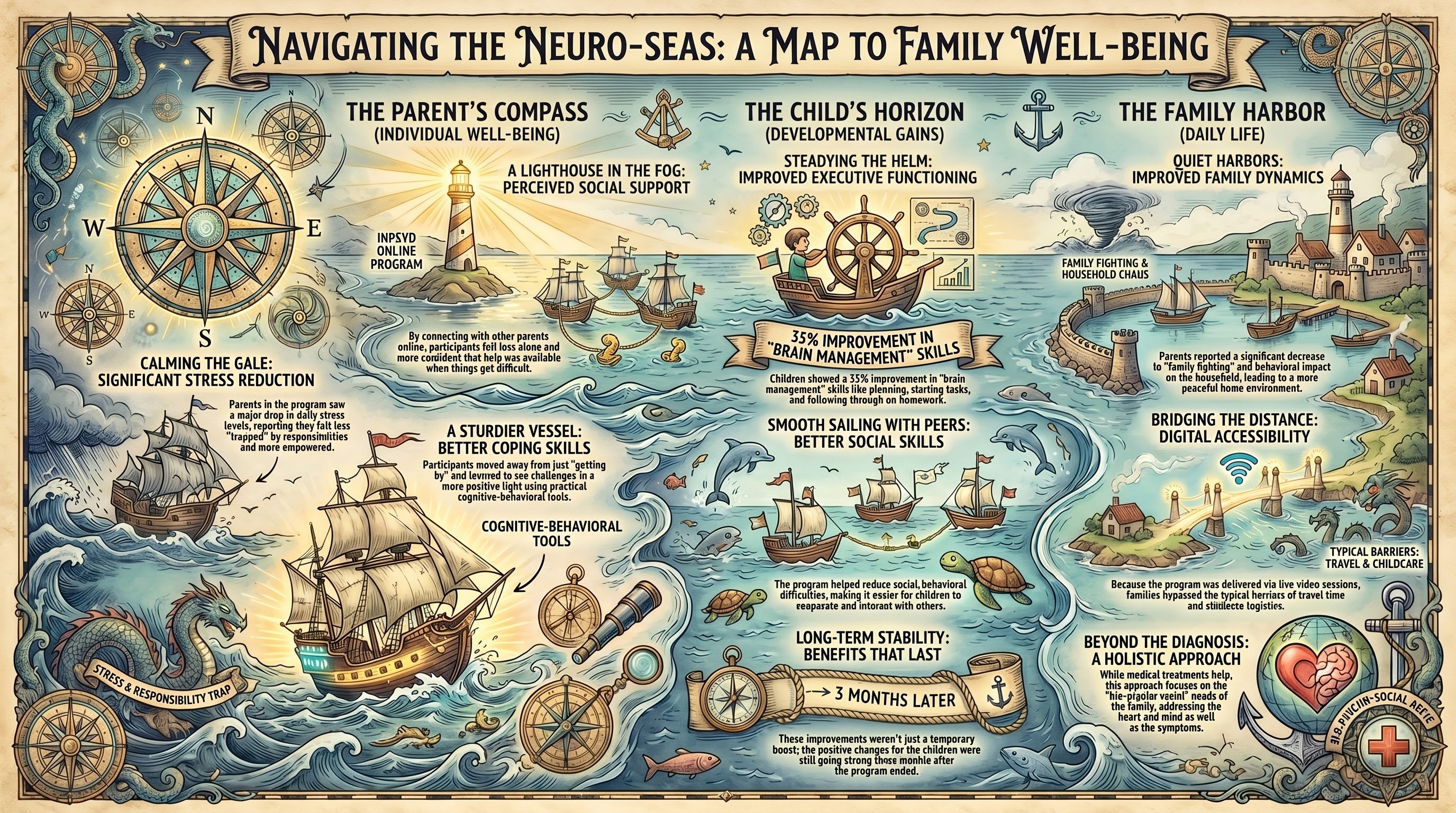
Researchers at the University of Valencia ran a randomized controlled trial of an online psychosocial intervention — INPSYD — for families of children diagnosed with autism or ADHD. Eighty-two families participated, children averaging around nine years old, with 81% boys. Half received the INPSYD program; the other half received a structured but non-therapeutic active control.
The differences at 12 weeks were clear. Parents in the intervention group reported significantly lower parenting stress, better coping skills, and greater perceived social support compared to the control group. But what makes this study particularly useful is that the gains didn’t stay with the parents. Children in the intervention group also showed improvements in social functioning, executive functioning, and the overall texture of family dynamics. Those gains held at the six-month follow-up.
Online delivery was not a compromise — it was the design. Families accessed the program from home. No travel, no waiting rooms, no coordination of childcare to attend a clinic. And the effects were real.
Why This Matters for Your Family
There’s a persistent assumption in parenting-intervention research that the good stuff happens in rooms: therapy rooms, clinic rooms, group rooms. This trial adds to a growing body of evidence that the format can shift without the outcomes collapsing.
For families of autistic or ADHD children — where scheduling is often complex, where one child’s support needs can make attending anything logistically heroic — the accessibility of online delivery isn’t a minor convenience. It can be the difference between an evidence-based intervention being available to you or not.
The finding that improvements in parenting stress and coping rippled through to children’s executive functioning and social behaviour also matters. It confirms what families often sense but rarely see measured: when the parents’ vessel is more stable, the children navigate better too. Calmer captains make calmer waters.
What You Can Do Today
- Search for online parent programs specific to your child’s diagnosis. Programs like INPSYD, Triple P Online, ADHD-specific telehealth programs, and national health system offerings have all expanded since 2020. Your paediatrician or GP may not know what’s currently accessible, but a short search on your national clinical trials registry or through your child’s diagnostic team may surface options.
- If you’re already stretched, start with coping skills, not behaviour management. This study measured three domains — stress, coping, and social support — and gains in all three fed child outcomes. Focusing on your own regulation first isn’t a detour; the data says it’s a direct route.
- If co-parents disagree: One parent wants to do a formal program; the other thinks “we’re managing fine.” The executive functioning and social gains in the children — measured as child outcomes, not only as parent stress outcomes — make a case that isn’t about parental deficit. It’s about what becomes possible when the system has more support. A trial of one term is low-risk evidence gathering.
The Original Paper
Pardo-Salamanca, A., Gómez, S., Santamarina, C., Pastor, G., & Berenguer, C. (2026). The effectiveness of an online-based psychosocial program for parents of children with neurodevelopmental disorders — a randomized controlled trial. Child and Adolescent Mental Health, 31(2), 96–105. https://doi.org/10.1111/camh.70044
Safety Note: This research summary is for informational purposes only and does not constitute medical or therapeutic advice. Always consult qualified professionals for your family’s specific situation. If you or your child are in crisis, contact your local emergency services or one of these helplines: 988 Suicide & Crisis Lifeline (US) | Lifeline Australia: 13 11 14 | Samaritans UK: 116 123 | Need to Talk? NZ: 1737
Research Brief
Generated by NotebookLM from the original paper. Not a replacement for the peer-reviewed source.
Read Full Brief →