Unpacking the daily dynamics of parenting strain: A 15-day diary study of caregiving role overload, depressive symptoms, and parental burnout among parents of autistic children.
Wang Lin, Hua Meng, Xie Qinxing, Yang Guang, Yu Yue, Chen Yuan
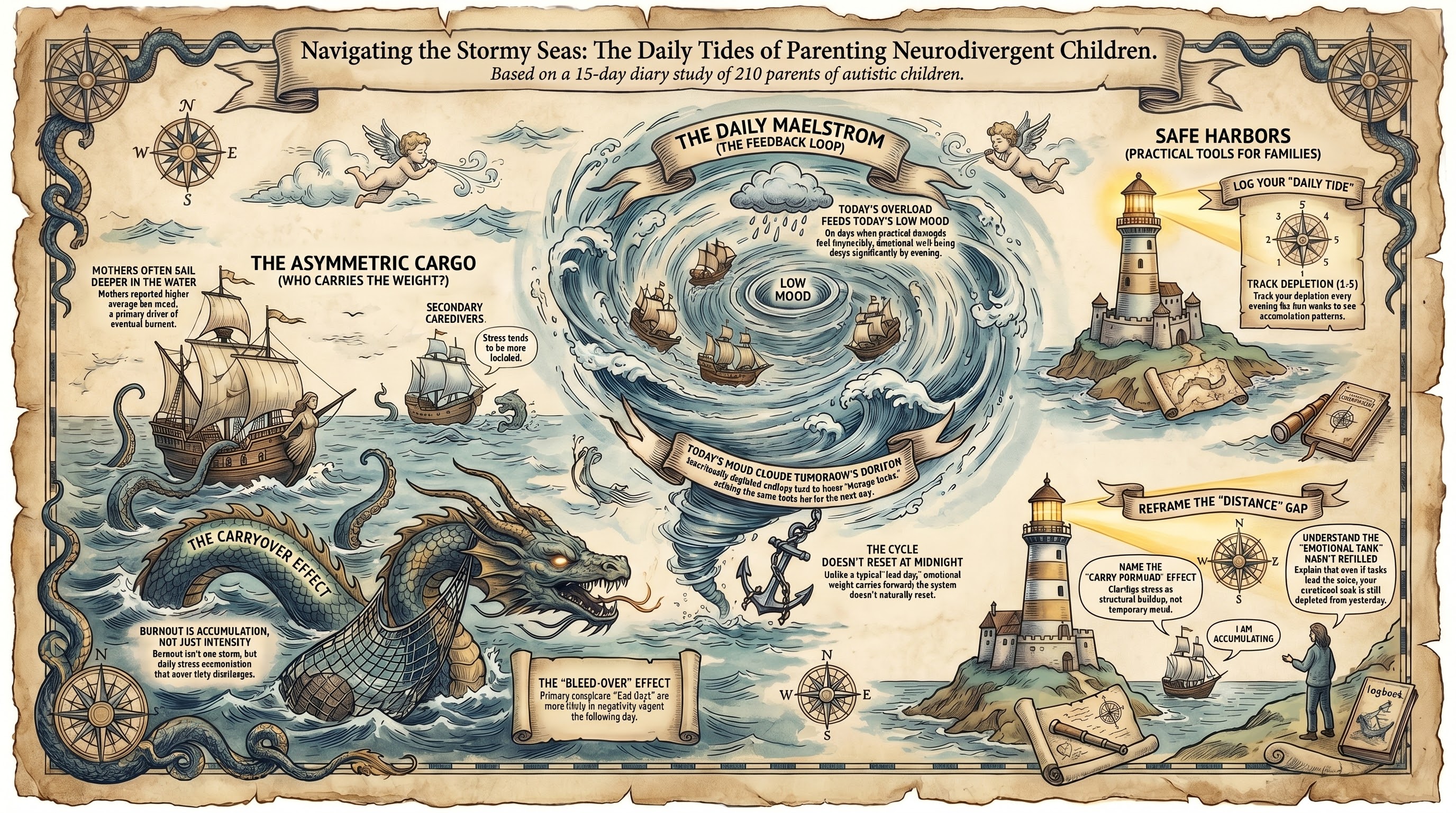
What This Paper Found
Researchers from the Education University of Hong Kong asked 210 parents of autistic children to complete a brief survey every evening for 15 weekdays across three consecutive weeks. What they tracked was simple: how much caregiving overload did you feel today, and how were your mood and depressive symptoms today?
The findings mapped a feedback loop that most of these families already know in their bodies. On days when caregiving demands felt overwhelming, depressive symptoms went up. On days when depressive symptoms were higher, caregiving felt even harder the next day. Each feeds the other, across days, in a cycle that doesn’t naturally resolve on its own.
But the study didn’t stop at the average. It looked at who was carrying that load. Mothers reported higher average depressive symptoms than fathers — and that difference predicted higher parental burnout. Mothers also showed stronger carryover: a bad day was more likely to bleed into the next day for mothers than for fathers. Both of those patterns predicted burnout independently. The diary method made visible what aggregate measures often miss: it’s not just the level of stress, it’s the day-to-day accumulation that depletes the tank.
Why This Matters for Your Family
There’s a version of this data that reads as obvious: of course primary caregivers burn out. What makes this study more useful than that is the mechanism it describes. It’s not just that the load is heavy — it’s that the emotional weight of yesterday makes today’s load heavier. The system doesn’t reset overnight the way it might for someone with a different daily experience.
For co-parents, particularly separated or divorced ones, this is data worth naming directly. If one parent is providing significantly more of the day-to-day care, the daily accumulation described here is playing out asymmetrically. That’s not a character flaw in either parent — it’s a structural dynamic with measurable consequences for mental health and long-term functioning.
The study also points toward what kind of support might actually interrupt the cycle: early, sustained, and individually tailored. Not a single session or a parenting course, but something that meets the parent in their daily experience across time.
What You Can Do Today
- Track your own load at the daily level, not just the weekly. Burnout often sneaks up because we normalize each bad day in isolation. A simple 1–5 rating of how depleted you felt today, kept for two weeks, can reveal patterns that aren’t visible from memory alone.
- Name the asymmetry explicitly with your co-parent if one of you is the primary carer. Not to assign blame — but because shared language about who is carrying what allows for more targeted repair. “I’m accumulating” is a more useful signal than “I need help” because it describes the mechanism, not just the symptom.
- If co-parents disagree: One may feel the other is overstating their load, especially from a distance. This research offers a useful reframe: the issue isn’t the volume of hard days but the carry-forward effect. Yesterday doesn’t fully discharge when you’re a primary carer of an autistic child. If that hasn’t been your experience, that gap is worth understanding before dismissing.
The Original Paper
Wang, L., Hua, M., Xie, Q., Yang, G., Yu, Y., & Chen, Y. (2026). Unpacking the daily dynamics of parenting strain: A 15-day diary study of caregiving role overload, depressive symptoms, and parental burnout among parents of autistic children. Research in Developmental Disabilities, 173, 105300. https://doi.org/10.1016/j.ridd.2026.105300
Safety Note: This research summary is for informational purposes only and does not constitute medical or therapeutic advice. Always consult qualified professionals for your family’s specific situation. If you or your child are in crisis, contact your local emergency services or one of these helplines: 988 Suicide & Crisis Lifeline (US) | Lifeline Australia: 13 11 14 | Samaritans UK: 116 123 | Need to Talk? NZ: 1737
Research Brief
Generated by NotebookLM from the original paper. Not a replacement for the peer-reviewed source.
Read Full Brief →