Emotion Regulation Treatment for Irritability and Disruptive Behavior: A Preliminary Investigation.
Turner K Amber, White Bradley A, Ollendick Thomas H
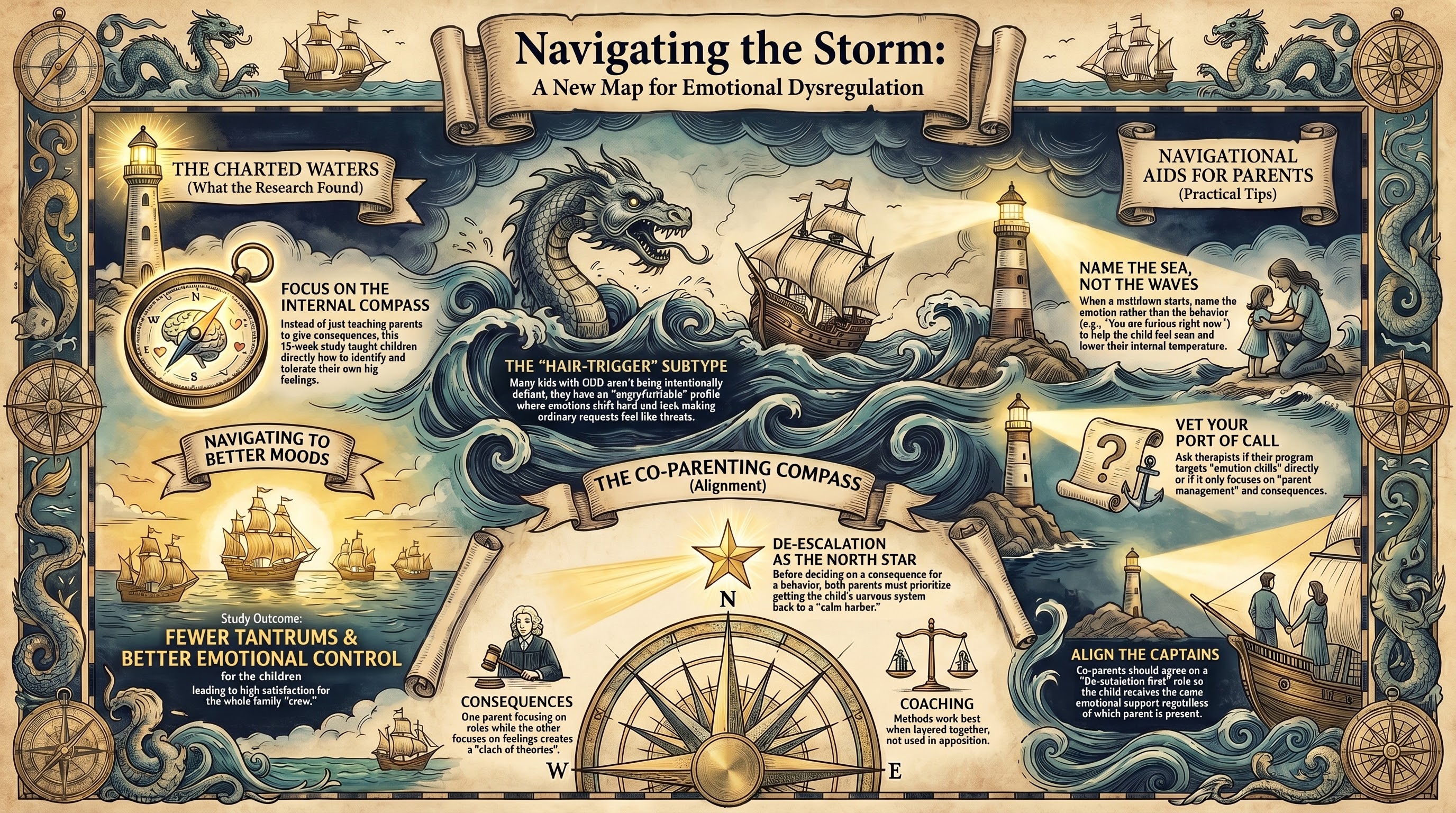
What This Paper Found
Most treatments for Oppositional Defiant Disorder hand parents a better toolkit and call it done. This study tried something different: it worked directly with the child’s emotions.
Turner, White, and Ollendick at Belmont University, the University of Alabama, and Virginia Tech enrolled seven children aged 8–11 with ODD — specifically the angry/irritable mood subtype, the kids whose behaviour looks like defiance but whose nervous system is running on a hair trigger. Over 13 weeks, children and their caregivers participated in a novel emotion regulation intervention that addressed what was happening inside the child, not just on the outside.
The results, while preliminary (seven children is a pilot, not a verdict), pointed in the right direction. Tantrum behaviour declined. Mood and emotion regulation measures improved. Families reported high satisfaction, and the treatment was delivered with strong fidelity. Crucially, the gains came from directly teaching kids to identify, tolerate, and regulate difficult emotions — not from giving parents new ways to enforce compliance.
Why This Matters for Your Family
If your child’s ODD sits under a roof of constant irritability — where ordinary requests seem to ignite something, where moods shift hard and fast, where the emotional thermostat seems permanently set too high — this paper is worth sitting with.
The distinction the researchers draw matters: a child in the angry/irritable ODD subtype isn’t primarily being oppositional. They’re experiencing emotional dysregulation that spills outward as opposition. Teaching them to manage their internal state is a different therapeutic target than teaching them to comply. And for families, that shift in framing can change everything about how you respond in the moment.
For co-parents navigating this together, the implication is practical and pointed. If one household is primarily using consequences to manage behaviour while the other is trying to address emotional escalation at its root, you’re not running the same strategy — you’re running two different theories of what the problem is. Getting aligned on the model matters before getting aligned on the method.
What You Can Do Today
- Name the emotional state, not the behaviour, when things are escalating. Before addressing the tantrum, try acknowledging the feeling: “You’re furious right now. That’s real.” Kids in this subtype often feel unseen — being named can sometimes lower the temperature.
- Ask your child’s therapist whether the intervention targets emotion skills directly. Many behaviour programs focus primarily on parent management. If your child’s ODD involves chronic irritability, it’s worth asking whether the child is also learning to work with their own emotions, not just experiencing consequences for them.
- When co-parents disagree on approach: One of you focuses on consequences, the other on emotional coaching. Neither is wrong — but they work best when layered, not competed. Agree on a shared “de-escalation first” rule across both households before deciding on consequences, so the child gets the same sequence of responses regardless of which parent is present.
The Original Paper
Turner, K. A., White, B. A., & Ollendick, T. H. (2026). Emotion regulation treatment for irritability and disruptive behavior: A preliminary investigation. Behavior Therapy, 57(3), 493–507. https://doi.org/10.1016/j.beth.2025.09.009
Safety Note: This research summary is for informational purposes only and does not constitute medical or therapeutic advice. Always consult qualified professionals for your family’s specific situation. If you or your child are in crisis, contact your local emergency services or one of these helplines: 988 Suicide & Crisis Lifeline (US) | Lifeline Australia: 13 11 14 | Samaritans UK: 116 123 | Need to Talk? NZ: 1737
Research Brief
Generated by NotebookLM from the original paper. Not a replacement for the peer-reviewed source.
Read Full Brief →