The New Forest Parenting Programme Shows Promise for Chinese ADHD Families
Zhang, Y., Liu, C., Li, B., Fu, X., Fong, H., Yu, Z., Wang, S., Jin, W., & Shi, L.
What This Paper Found
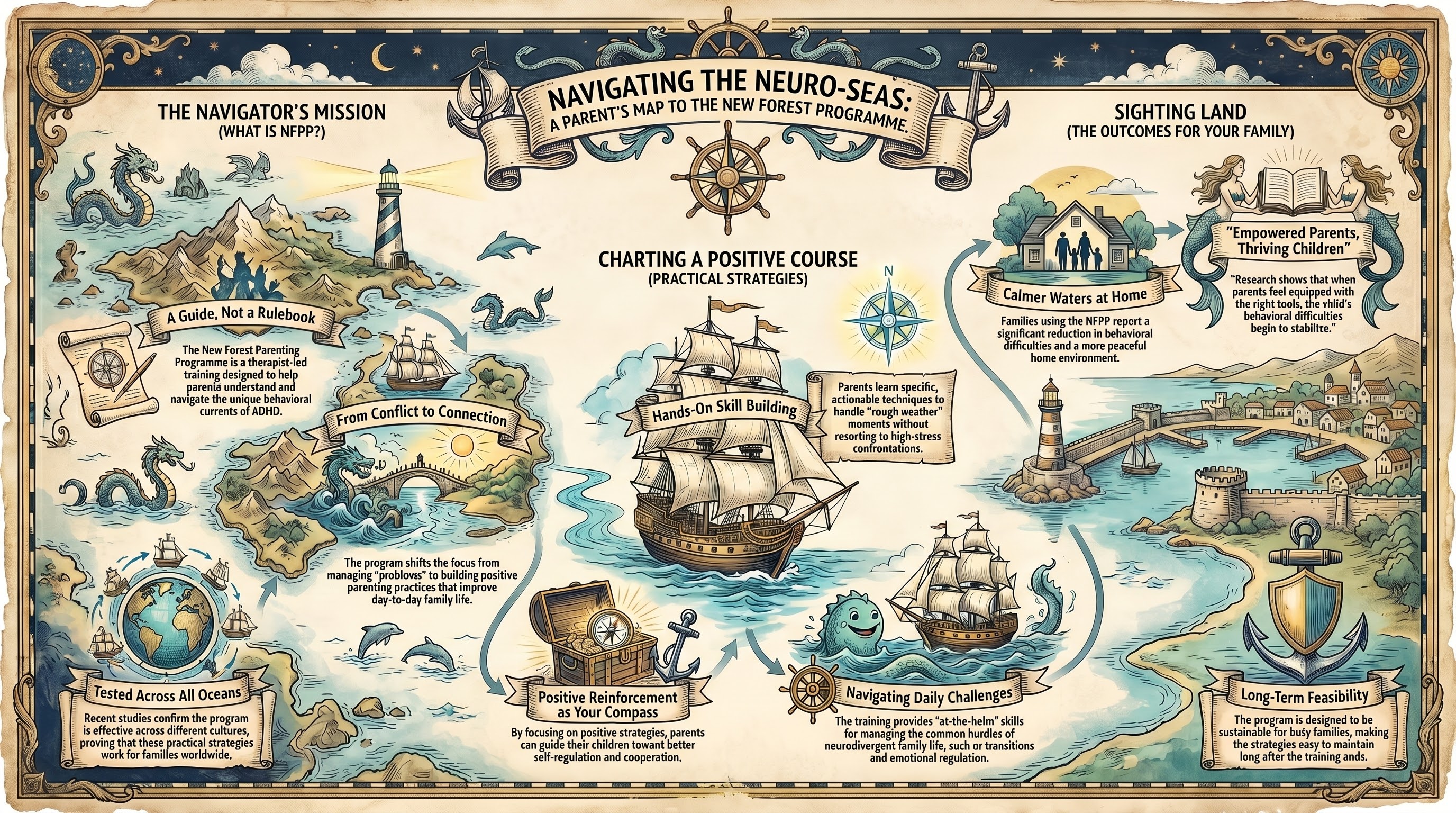
The New Forest Parenting Programme (NFPP) is one of the most studied parent training interventions specifically designed for ADHD. Unlike generic behaviour management programmes, NFPP teaches parents to understand why their child’s brain works differently — and builds strategies around that understanding. It’s been shown to work in the UK, Scandinavia, and other Western countries, but this is the first study testing it with Chinese families.
The researchers found that NFPP was both feasible and effective in this entirely different cultural context. Parents learned the strategies, stuck with the programme, and — critically — saw meaningful improvements in their children’s behavioural difficulties. The fact that this approach transfers across such dramatically different parenting cultures suggests the underlying principles aren’t Western-specific. They’re human-specific.
Why This Matters for Your Family
If you’ve ever wondered whether the strategies in Chapter 4’s “Passage Plan” or Chapter 5’s “Storm Protocol” are really universal, this study is encouraging. The core insight — that understanding your child’s neurology changes how you respond to their behaviour — works whether you’re in Southampton or Shanghai.
What’s particularly relevant for co-parents: NFPP focuses on positive parenting practices, not compliance-based discipline. It doesn’t try to make the child “behave better” through consequences. It helps parents build scaffolding around executive function gaps — which is exactly the approach this book takes. When both captains understand the neurological why, the disagreements about the behavioural what tend to ease up.
The programme is therapist-delivered and relatively brief, which matters for families already stretched thin. You don’t need a year of weekly sessions. Even short, structured interventions can shift the dynamic meaningfully.
What You Can Do Today
- Ask your child’s clinician about NFPP or similar ADHD-specific parent training programmes. Generic “parenting classes” are not the same thing — look for programmes that teach neurodevelopmental understanding, not just behaviour management.
- Try the “why before what” approach at home. Before reacting to a difficult behaviour, pause and ask: what’s the executive function gap driving this? Is it working memory? Impulse control? Emotional regulation? (Chapter 2’s “Field Guide” has a quick reference.)
- Share this with your co-parent as a conversation starter. The finding that these strategies work across radically different cultural contexts reinforces that this isn’t about parenting style — it’s about understanding your child’s brain.
The Original Paper
Zhang, Y., Liu, C., Li, B., Fu, X., Fong, H., Yu, Z., Wang, S., Jin, W., & Shi, L. (2026). The effectiveness and feasibility of the new Forest parenting programme for Chinese children with attention-deficit/hyperactivity disorder and their families. Acta Psychologica, 106492.
Safety Note: This research summary is for informational purposes only and does not constitute medical or therapeutic advice. Always consult qualified professionals for your family’s specific situation. If you or your child are in crisis, contact your local emergency services or the 988 Suicide & Crisis Lifeline.
Research Brief
Generated by NotebookLM from the original paper. Not a replacement for the peer-reviewed source.
Read Full Brief →