New Horizons - Adapting As Your Child Grows
Preview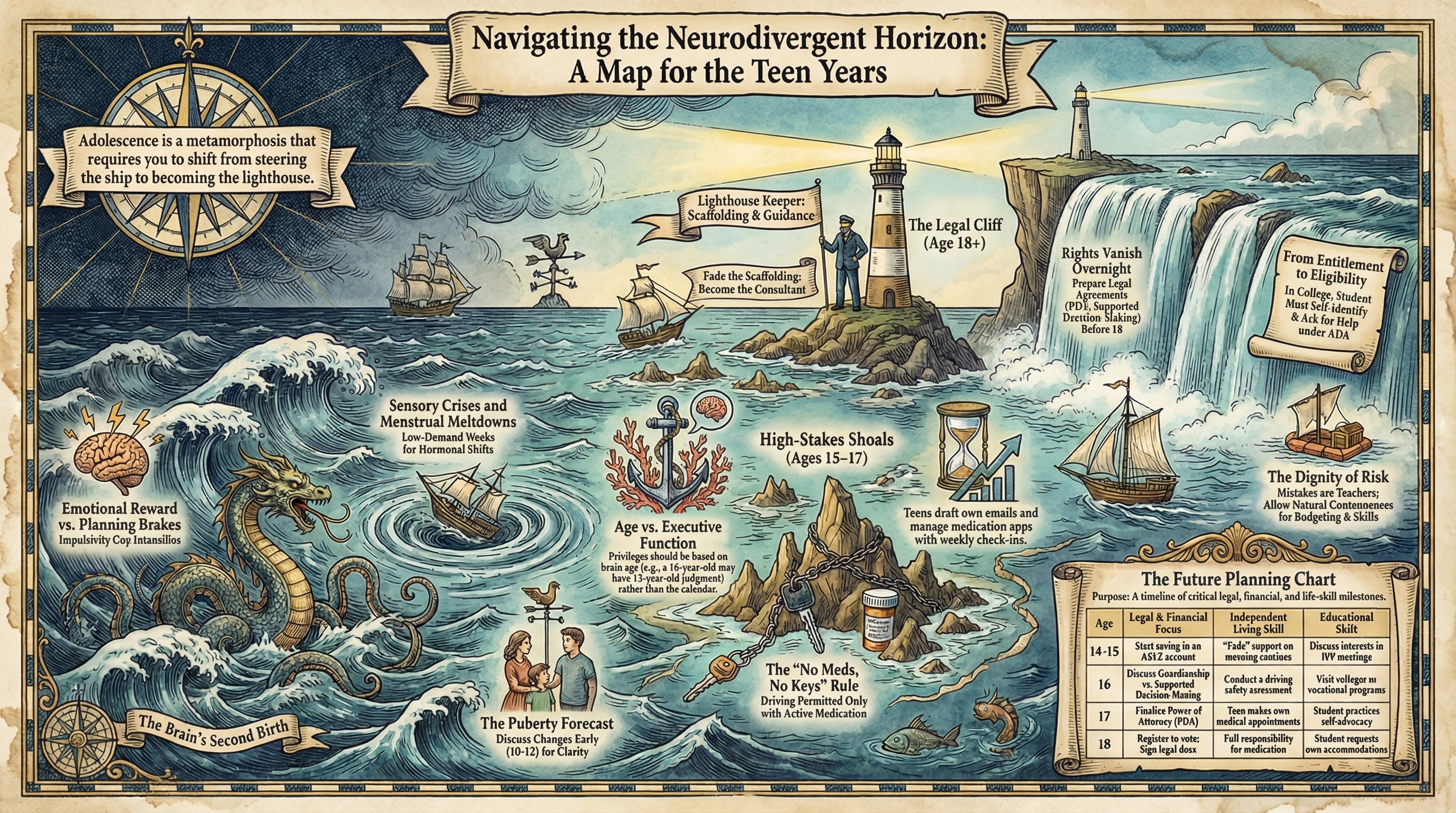

Quick Map: If you only read one page, read this
- The Shift: Your role evolves from "Primary Navigator" (active steering) to "Harbor Master" (shore-side guidance and support).
- The Second Birth: Puberty is a neurological storm. Hormones act as accelerants for ADHD impulsivity and sensory sensitivities.
- The Driving Contract: Driving is a privilege tied to executive function, not age. Many families use a "no meds, no keys" rule in consultation with the prescriber.
- The Legal Cliff: At 18, your legal rights vanish. Prepare early with Supported Decision-Making (SDM) or Power of Attorney (POA) agreements.
- The Dignity of Risk: Your adult child has the right to make mistakes. Protective guardianship often prevents this critical learning.
Field Guide: The Science of the Adolescent Neurodivergent Brain
What's happening in the brain/body: Adolescence triggers a massive neural reorganization driven by gonadal hormones. In neurodivergent brains, this can create a "developmental mismatch": the limbic system (emotions, rewards) matures faster than the prefrontal cortex (brakes, planning). For ADHD teens, cortical maturation can lag and puberty widens this gap. For autistic youth, pubertal timing can be earlier in some girls, which may intensify sensory and emotional challenges. For girls, menstruation can become a sensory crisis that triggers severe meltdowns due to interoceptive differences.¹ ² ⁴ ⁵ ¹⁵
What it looks like at home: Your child may take massive risks (impulsive driving, substance experimentation). Autistic girls experience "menstrual meltdowns" linked to hormonal phases. Demand avoidance intensifies as teens assert autonomy. School refusal spikes as social hierarchies become exhausting. The teen may also begin questioning her identity, seeking authentic self-expression.
What helps:
- Anticipatory planning: Discuss puberty (hygiene, driving) at ages 10-12, before the storm hits.
- Low-demand weeks: Relax expectations during pre-menstrual phases.
- "No meds, no keys" rule: Driving is tied to executive function readiness, not age. If used, align it with the prescriber’s guidance.
- Graduated independence: Use scaffolding—do tasks together, then watch them solo with check-ins.
- Identity affirmation: Create a safe space for exploration; parental acceptance is a critical harbor.
- Early legal planning: Begin SDM or POA discussions at 16-17.
What backfires:
- Forcing "normalcy": Trying to force masking or rigid rules triggers rebellion.
- Overprotection: Preventing all risks creates "failure to launch"; they need to learn from mistakes.
- Comparing timelines: Your teen's executive function may be years behind their peers.
- Skipping the talk: Leaving autistic teens without information leaves them vulnerable to exploitation.
- Disagreeing on safety: Split parental rules on driving create dangerous dynamics.
One sentence to remember: "Adolescence isn't just physical growth—it's a neurological metamorphosis that requires you to shift from steering the ship to becoming the lighthouse."
Introduction: The shift from Captain to Lighthouse Keeper
In the early years, you were the captain — steering every decision, managing every storm, reading every signal. But as your child approaches adolescence, the role shifts. You are no longer at the helm. Your child is learning to steer, and your job becomes the lighthouse: a steady reference point for safety, not the force of propulsion.
This chapter is the "long game" of neurodivergent parenting. The patterns you mapped in early childhood become more complex in adolescence. We're zooming out from daily survival to look at what's ahead: the physiological upheaval of puberty, the quest for identity, the legal shifts at 18, and the evolution of your own role.
Continue Reading
Unlock the full content including Tactical Strategies, Parent Toolkit, and Survival Card.
Get Full AccessPay what you can - from $5